

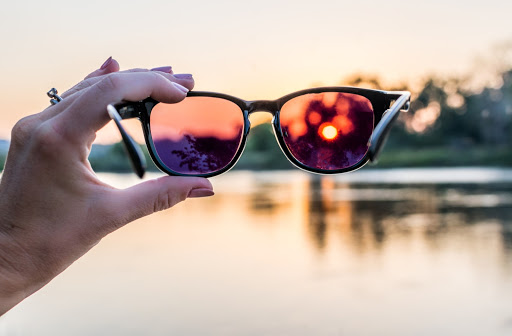
Have you ever been driving and suddenly experienced the glare off of another car’s hood making you lose sight of where you were headed? Or perhaps you’ve been on a boat during your last vacation, but instead of enjoying the beautiful scenery, all you could focus on was the light reflecting off of the water straight into your eyes.
Regular sunglasses have done wonders for protecting our vision, but sometimes you may need to take it a step further and explore the benefits of polarized sunglass lenses. Below you’ll find some important information to consider when determining which pair would best suit your needs.
How Polarized Lenses Work
Sunlight travels in all directions but becomes polarized when it reflects off of flat surfaces. This polarization causes the light to travel in a more uniform, often horizontal direction, which can become a nuisance with its sometimes dangerous intensity, by causing glare and reducing visibility.
Polarized lenses contain a specialized filter that blocks this intensely reflected form of light, helping to reduce glare and discomfort. However, there are also instances where polarized lenses may not be the best option, such as events where identifying reflected light may be beneficial, for example, downhill skiing and needing to spot icy patches on the trail to identify hazards.

However, these specialty lenses also tend to reduce the visibility of images produced by liquid crystal displays (LCD’s), which can be found on some digital screens such as:
- Automated teller machines (ATM’s)
- Gas station fuel pumps
- Some cell phones and mobile devices
Even with these exceptions, polarized lenses are a great option for decreasing eye strain and discomfort in bright sunlight.
Other activities where polarized lenses are favorable
- Fishing and boating (improved ability to see objects under the surface of the water)
- Being frequently in and out of the sun (polarized sunglasses with photochromic lenses)
- Spending time outdoors, over the age of 40 (polarized sunglasses with progressive lenses)
Any time that glare may become an issue and you’re looking for some added comfort, polarized sunglasses may be the best choice. Ask your eye care professional to go through the benefits and potential drawbacks with you during your next visit, so that you can decide which option best suits your lifestyle needs.